AI is a different kind of tech boom. This time it’s competitive.

Simon Molloy
February 2026

BIG TECH, LITTLE COMPETITION

Since the 1950s, beginning with the IBM dominated mainframe computer era, the world has watched successive waves of tech booms but to AI boom is different in a fundamental way: it’s much more competitive.

The personal computer era was supposed to democratize information processing. Instead, Microsoft captured the market so completely it faced antitrust action by the late 1990s. In those days Apple was just a bit player.

The Internet was going to be an open commons of human knowledge. Today, Google has captured over 90% of global search, while Meta’s platforms mediate the social lives of three billion people. Search and social media, it seems, were highly susceptible to monopolisation.

Although other players tried to enter the smartphone market (remember Amazon Fire?), it quickly collapsed into the Apple Android duopoly.

These outcomes weren’t accidents. They were the predictable result of fundamental structural characteristics of these markets: economies of scale, network effects, high switching costs and winner-take-all dynamics.

The AI revolution, however, appears to be following a different script. For the first time in computing history, we’re witnessing a genuinely competitive technological boom – one where multiple players with distinct approaches, philosophies, and business models are vying for dominance without any single entity approaching monopoly status. Moreover, significant drivers of future monopoly outcomes have yet to emerge.

This competition also extends across national borders and, indeed, is seen widely as a driver of geo-strategic outcomes.

This critical difference, if it persists, could fundamentally alter the relationship between technological innovation, consumer welfare and the returns to those trillions of dollars of AI investment.

MARKET POWER IN TECH HISTORY

Economists are very interested in competition, because it’s competition that delivers the benefits of markets to consumers. In any Economics 101 course you will find the classic description of the spectrum of decreasing competitiveness (and increasing market power) from the theoretical optimum of perfect competition through monopolistic competition, oligopoly, to pure monopoly.

Perfectly competitive markets are rare if they exist at all (other than in the minds of economists). Usually, market structures end up somewhere between the polar cases of monopoly and perfect competition.

What makes the current AI moment distinctive is that it appears to be settling into a market structure of genuine monopolistic competition: where many firms offer differentiated products (Claude vs ChatGPT vs Gemini vs xAI vs DeepSeek) with, and this is critical, relatively low barriers to consumer switching. Each firm commands some market power through product differentiation rather than via scale and network effects.

In contrast, Microsoft’s triumph in personal computing grew out of its cultivated application ecosystem: as more users adopted Windows, more developers wrote Windows software. As more Windows software became available … you know how it goes. The natural monopoly characterises of operating systems was also crucial (why on earth would we want ten OSs?).

It took Google half a decade to achieve such dominance that it became a new verb. Facebook managed to destroy virtually every social networking competitor, from MySpace to Google+ and absorbed Instagram and WhatsApp while regulators were scratching their heads trying to understand digital dominance.

The pattern is clear: a technological wave may begin with apparent openness and competition but then, because of underpinning structural features, these markets rapidly consolidate around one or two dominant players who capture the majority of economic value.

The market power of the winners is manifested in their incredibly high margins. Microsoft reached peaks near 45% in the 2000s, while Google’s search business earned gross margins of 75%. These levels dwarf traditional industries where automakers operate at 5-10% margins and retailers often below 5%.

So, the trillion-dollar question is: will AI’s monopolistic competition collapse into duopoly or be dominated by a single player? The answer to this question is central to determining how the benefits of AI will be distributed between AI investors and consumers of AI services.

THE STRUCTURAL DIFFERENCES OF AI COMPETITION

Several factors distinguish the current AI boom from its predecessors, and these differences appear structural rather than merely circumstantial. Creating a competitive search engine in 2010 was nearly impossible; Google’s head start in indexing the web and understanding user intent was insurmountable. Building a competitive AI model in 2025, by contrast, requires significant capital, computational resources and talent, but these inputs are available to multiple players. The models themselves, once trained, don’t benefit from the same kind of network effects that made Google’s search algorithm better with each query and Facebook more attractive with each additional user.

More fundamentally, AI lacks the natural monopoly or network characteristics of previous platforms. ChatGPT doesn’t become more valuable to me because more people use it. Claude doesn’t improve for individual users because Anthropic gains market share.

The main driver of this characteristic would appear to be the separation of training and inference in AI models. Any innovation in AI models that improves performance based on interactions with users would create network effects that could lead to market dominance. But that’s not how LLMs work. Not yet, anyway.

It’s tautological to say that, in the world of hyperscaling, economies of scale matter. While economies of scale can drive consolidation, in the case of AI, there is no clear early entrant that looks set to win the race for scale. Moreover, economies of scale don’t necessarily lead to winner-take-all outcomes, especially in very big markets. The automobile industry, for example, exhibits huge economies of scale but there are still many auto producers around the world.

The current AI market manifests this openness. Google, despite being an incumbent tech giant, isn’t running away with the AI market. Industry colossus, Microsoft, through its partnership with OpenAI, has tried to reenergize its consumer offerings but hasn’t achieved dominance. OpenAI, the apparent early leader, faces serious competition not just from tech giants but from well-funded startups like Anthropic and xAI. And then there’s DeepSeek.

Even the business models remain unsettled. Some companies offer subscription services directly to consumers. Others focus on API access for developers. Some pursue advertising-supported models, while others avoid advertising entirely and emphasise security and privacy.

WHY THIS MATTERS FOR CONSUMERS

The persistence of competition matters enormously for end users, and not merely because it keeps prices in check. Monopolistic tech platforms have consistently demonstrated that once they achieve dominance, the innovation that serves user interests takes a back seat. Facebook’s steady degradation of the user experience in favour of algorithmic content and advertising offers a clear example, as does Microsoft’s lazy last two decades of the twentieth century.

Competitive markets, by contrast, must continue innovating to retain users. When Anthropic emphasizes safety and controllability in Claude’s design, it’s not merely virtue signalling, it’s competitive differentiation. When Google integrates AI into search, it’s defending against the possibility that users might abandon search for AI-native information discovery. The bottom line? Consumers win.

CAUTIONARY TALE FOR INVESTORS

The message for investors, however, is less rosy.

It may be that tech investors may have an unconscious assumption that all tech companies will have the market power that they have enjoyed in the past – the deep wide moats around market shares and the associated persistently high margins.

But what if AI company profit rates look less like Google advertising and more like main street retailing?

There’s no shortage of financial pundits claiming that AI is an investment bubble; that AI revenue can never repay the stupendous investments.

What kind of assumptions about margins are these pundits baking into their prognostications? Harris Kupperman, Founder & Chief Investment Officer of Praetorian Capital Management, who argues the boom is a bubble, speculates: “say that ultimately, the margins get to positive, and then gradually creep up towards 25%. Why 25%? I have no idea. It just sounds right.”

There aren’t too many retailers on the planet who wouldn’t kill for a margin of 25%.

If a critic of the boom assumes 25%, what are the boosters assuming?

Competition means lower prices and lower prices usually mean lower margins and revenues. If AI’s market structure ends up being more like monopolistic competition and less like monopoly, the prospects of investors ever making a return become much much dimmer.

For emphasis, it doesn’t matter how good AI gets, how much value it adds; in a competitive market revenues are pushed down towards costs and margins stay low.

UNCERTAIN AI ROAD AHEAD

There is no guarantee that AI will remain as competitive as it is now. Network effects could emerge in unexpected ways. The enormous computational resources (including electricity) required for training frontier models might ultimately be accessible only to the largest tech companies, creating an effective oligopoly by resource constraint rather than market dynamics.

The structure of the current moment is genuinely different from tech booms we’ve seen before. The absence of strong network effects, the low switching costs, the genuine diversity of well-funded competitors, and the ongoing uncertainty about which business models and technical approaches will prove superior are factors creating conditions for sustained competition that previous technology revolutions lacked.

Or maybe a bursting bubble will, in the end, force consolidation, in which case some investors will win and others will lose.

But maybe AI will turn out to be, like so many other industries, competitive enough to shift value and benefits in the direction of consumers rather than shareholders.

Could AI be the first pro-consumer tech boom?

Maybe this is, finally, the revenge of the nerds.

Simon Molloy is Managing Director of Systems Knowledge Concept, an Australian technology and communications economics consultancy. 

BUYING JEANS: A CONSUMER SURPLUS PARABLE

Say you’ve come down from the office to go out for lunch. Out in the street you see a clothing pop-up store with nice jeans at $100 a pair. You have a quick look thinking that you do need a new pair of jeans but, at $100, they’re a bit expensive. On your way back from lunch you see the pop-up store is closing down for the day and the jeans you like have been marked down to $50. You go and buy a pair. From this observed behaviour we can conclude that your subjective, personal, internal valuation of those jeans is somewhere between $100 and $50 – we don’t know exactly what it is, but we know it’s somewhere in that range. Let’s assume that your internal valuation is $75. That explains why you wouldn’t buy at $100 but would buy at $50. So, by buying the jeans you have made yourself $25 better off, that is, the $75 better off you are now because you own those jeans minus the $50 you had to pay to get them. This $25 is like a kind of ‘personal profit’ that you make from the purchase. It’s actually why you make the purchase. Economists call this personal profit, consumer surplus. Consumer surplus, or at least the expectation of it, is what drives all transactions everywhere. It is by the creation of consumer surplus that markets create value and benefits for society.

We can extend this idea of consumer surplus from the individual to an entire market. Imagine we had some alien tech way of knowing the internal subjective evaluation of everybody who bought jeans in a particular city on a particular day – some kind of valuation mind-reading device. And assume also that we know the price that everyone paid and the number of jeans that were sold. Now we can work out the total consumer surplus for everybody who bought jeans on that day – or total market consumer surplus. Now we can say how much better off society was made on that day because of the existence of a market for jeans.

Note that we don’t need the alien tech mind scanning device to enable markets to work their magic – markets achieve the creation of consumer surplus value simply through the many interactions of individual buyers and sellers in the marketplace.

This is how markets make society better off. I’ll just note in passing that there is a boatload of assumptions behind this little story, but it serves to illustrate the point.

Notice one more thing: the price of something is what someone is willing to pay for it. What a market does is find that price. This price is one measure of value. The idea of consumer surplus is another and complementary idea of value.

The critical thing is, when a market is operating well (and we don’t have time to talk about what that means even though it’s very important) it generates prices. We don’t need to come up with a valuation method when markets are operating precisely because a market is a valuation method. But when we don’t use markets and governments provide goods or services we need other methods to determine what they are worth to society.

Finally, value is a multi-dimensional and subjective concept. The starting question is: ‘value to whom?’ The answer to what is value depends, among other things, on whether we’re talking about an individual, a family, a region, a state and country or the planet in relation to their respective populations.

From Napster to now: reflecting on how the ‘free stuff’ brigade took the high moral ground in copyright debate

cropped-skc-website-banner-e1469582802173.png

Simon Molloy, July 2016

Copyright ground zero

June 1999 was the dawn of a new era in the public’s attitude to copyright. Around the USA, a flood of low quality MP3 music files was rushing onto student computers along the high speed Internet connections of college campuses.

Napster had launched the age of online digital music. The access was unprecedented, the price was right. It was Good. Clearly, it was breaching copyright laws. This was a Problem. Something this Good had to be somehow made ‘ok’. Arguments soon appeared:

  • the record companies unreasonably limit access to back catalogues and obscure material (but the hits were the big downloads and why would record companies publish and distribute loss making titles?)
  • the record companies package weak songs with the good ones on overpriced albums (the artists write the songs, not the record companies)
  • students can’t afford to pay for music (for the first time in history)
  • downloading will lead to increased CD sales anyway so artists will benefit (it didn’t, CD sales collapsed)
  • the MP3s were only low quality – people wouldn’t be satisfied with MP3s and would soon return to CDs (MP3s got better)
  • artists can earn income in other ways such as live performance (most of them were already doing that)
  • you couldn’t actually rip-off the artists because they were already being ripped-off by the record companies (a personal favourite).

And so it went. Yet, despite the weakness of their arguments, the free stuff brigade managed to position themselves as the good guys instead of ending up being branded the opportunistic copyright thieves. A number of the arguments cited above claimed ‘no harm, no foul’ – free MP3s will encourage CD sales. But one of their central arguments clearly demonstrated their lack of regard for the welfare of artists – that artists would create ‘for the love of it’ even if they were denied income from their works.

US folk singer, Gillian Welch, put it this way in her song, Everything is free:

Everything is free now
That’s what they say
Everything I ever done
Gonna give it away

Someone hit the big score
They figured it out
That we’re gonna do it anyway
Even if it doesn’t pay

(Gillian Welch, Everything is free, 2001)

For some of us it is difficult to embrace the idea of wanting to enjoy the works of a living artist while being indifferent to their fate. For others, no so much. Still, it’s counter-intuitive that the free stuff brigade found their way so easily on to the high moral ground.

The value of the high ground

In all social and economic debate, it is greatly advantageous to occupy the moral high ground.

For example, when it comes to social safety net policy, the proponents of fiscal rectitude find it hard to counter the calls of compassion for the needy and ‘save the planet’ goes a long way to frustrate the pleas of economic growth enthusiasts.

In fact, it’s not always obvious what argument should occupy the moral high ground. For example, those who argue for reining in social welfare payments claim that burdening future generations with our profligacy is a greater evil than reluctantly reducing social welfare expenditures.

Unfortunately, the contest for the high ground can displace pragmatic argument. The vast majority of us want a safety net for those in need but of course don’t want to create perverse incentives and unsustainable debt. We know that the art of policy is in finding the right balance. But in the age of social media outrage is the new reason. Careful numerate analysis doesn’t cut through, doesn’t go viral.

The point is that substantial benefits flow to the proponents who can shape and position the arguments that colonise the moral high ground. This is mostly because asserting a moral imperative transcends the need to sort through the messy ambiguous trade-offs, costs and benefits that are associated with real policy decisions – if it’s too hard to decide what’s the best thing to do, just do what seems right.

Economics and ‘free stuff’

The proponents of free music soon discovered that their rallying cry was already in place; first uttered by Stewart Brand at the inaugural Hackers Conference in California way back in 1984 – information wants to be free.

The functional translation of this appealing anthropomorphism was: ‘not only is ‘free’ desirable, it makes society better off as well’. Now it was not only ok to get free stuff, but at the same time one could occupy the intellectual and moral high ground.

Like all ideas that spread and persist, this slogan contains a grain of truth. The theoretical well-spring of that grain of truth is to be found in the economic theory of public goods.

A pure public good is kind of a weird thing – it’s a ‘good or service’ which is both completely non-rivalrous and non-excludable. Non-rivalrous means that if one person consumes the public good, there is no less of it for another to consume: a television broadcast is an example – if I tune in, it doesn’t cause you to get a weaker signal. Non-excludable means that once the public good is made available to one consumer, it is not possible to exclude any other consumer from enjoying it, for example, national defence or a fireworks show. Non-excludability is a problem because who would want to fund and produce something that you can’t stop people from consuming? We’ll return to this point later.

In economic theory, public goods are clearly delineated from private goods which are both non-rivalrous and excludable – once I have eaten that hamburger, there is none left for you (rivalry) and the guy behind the counter won’t hand over the hamburger until he is pretty sure I am going to pay for it (excludability).

In the digital online world, a catalogue of music can be shared at near zero cost and perfect copies can be endlessly made – the magic of online digital distribution changed music from a private good (tracks on a physical CD) into a public good (MP3 files on a server).

New technologies mean that the marginal cost of provision has become zero (or very close to). Critics of copyright argue that production or ‘first copy’ costs are sunk costs and should be disregarded because society will be made better off if everyone who values something at more than what it costs to provide it can have it – if one person is made better off at no cost, society is, by definition, better off.

So, by sharing ‘free stuff’ around the world, you are actually making society better off. Now that’s an idea that is tailor made to take the moral high ground!

It’s not just about now

But wait. There’s a flaw in this thinking. One of the glaring problems with the idea that information wants to be free is that it is based on a static perspective. It implicitly dismisses the future, in particular, the responses of the creators of future copyright works and the benefits that society may enjoy from the flow of future works.

It is true that widely dispersing current works benefits society. This is obvious. But the ‘zero marginal cost’ argument is partial and misleading. When confronted with the question of the flow of future creative works the response of the ‘free stuff’ brigade is that artists will continue to produce these works ‘for the love of it’ or because they ‘can’t help themselves’. As Gillian Welch puts it “That we’re gonna do it anyway/Even if it doesn’t pay”.

This is not only an unprincipled and demeaning view of the creative process, it is also misinformed and impractical.

There may be some artists who are at the mercy of their creative impulses but many, faced with impoverishment will find something else to do. Others will simply not embark on a path of professional creativity.

Those who imagine that producing creative outputs in the modern world is down to the lone artist are simply wrong. Producing a finished song requires not only initial creative impulse but also technicians, producers, recordists etc. but also promoters and marketers and so on if it is ever to reach a wide audience. How will all of these inputs be attracted and financed if recorded music generates no revenue?

Those who argue that access to cheap powerful digital recording and distribution tools enables the artist to undertake all of these functions are missing the point. If artists take on all these other roles, they are spending less time being artists.

And so we return to the question of funding. If music has effectively become a public good, who will fund it? Who will bring all the various skills and resources together to produce music at a professional level? One answer is government. Governments fund many public goods which would otherwise not be produced. But somehow the idea of a Department for Popular Music doesn’t quite fly. In the information wants to free world we may have to accept that lower levels of resources, human skills and ‘artfulness’ are, on average being bought to new music.

‘Free stuff’ or art

All in all, it is difficult to sustain the argument that reducing the returns to some activity to near zero will not reduce the resources flowing into that activity. Another serious misconception is to imagine that this loss of income for artists will result only in a reduction in the volume of output. The effects are much more widespread and pervasive: the nature of the art form changes, artists are less committed (out of necessity), careers are shorter, there is more emphasis on the back catalogue than on what is new and so on. The effects of large changes in incentive structures manifest powerfully and unpredictably, especially in the long run.

Gillian Welch continues:

Every day I wake up
Hummin’ a song
But I don’t need to run around
I just stay home

And sing a little love song
My love, to myself
If there’s something that you want to hear
You can sing it yourself

(Gillian Welch, Everything is free, 2001)

Which is to say, that if we choose a system that doesn’t reward artists, we are not going to encourage them to produce the very thing we want from them.

Free now, pay later

Ultimately, winning the moral high ground requires not only a plausible moral argument but the right tactics and politics and a winning narrative.

It’s telling that the proponents of free stuff don’t often challenge directly the fundamental principle of copyright – that artists have rights over their creations.  The arguments are mostly about the messy details of things like the role of the record companies, access to back catalogues, forms of artist income, the mechanics of promotion, the price of music, and so on.

Copyright isn’t dead, it’s that the political will to support it has been dissipated by the cursory moral appeal of the ‘information wants to be free’ aphorism and the way it has been positioned by its proponents. They have also been able to harness the idea that the newness and change are inherently preferable to the status quo, which is to say their position is regarded as an idea whose time has come.

Upon closer examination, the copyright debate looks remarkably like debates about climate change and budget deficits: we want growth but we don’t want to overheat the planet; we want government benefits but we don’t want unsustainable debt, but, in general, we want it now despite the future consequences. We shrug our shoulders as myopia wins again.

The supporters of copyright could potentially regain some footing on the moral high ground by pointing out their opponents want ‘free stuff’ now even at the cost of imposing a more culturally impoverished world on future generations.

Perhaps the aphorism ‘there’s no such thing as a free lunch’ contains a greater truth than ‘information wants to be free’.

The economic paradox at the heart of the app economy

cropped-skc-website-banner-e1469582802173.png

Simon Molloy
June 2016

THE RISE OF THE APP ECONOMY

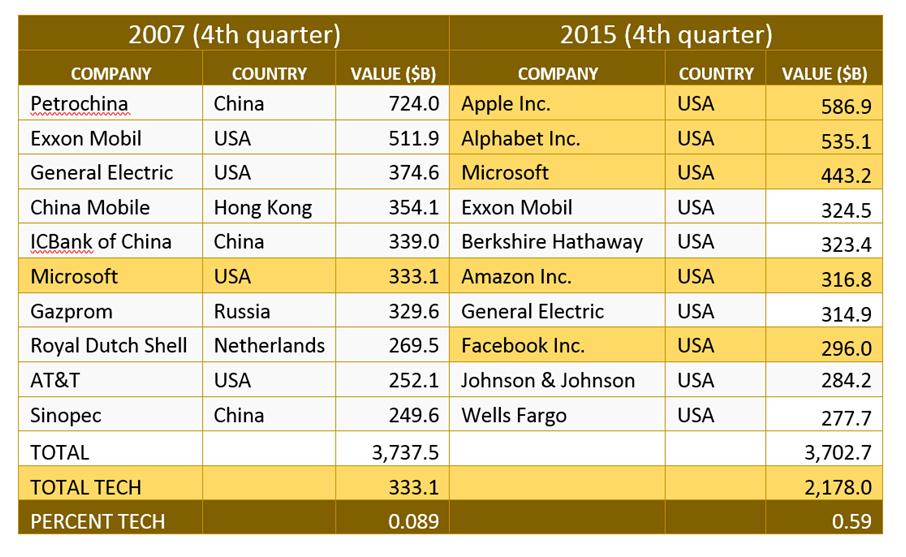
Spend a moment with the table below. It shows the top ten publically traded companies in the world by market capitalisation. Yes, that’s 2007 to 2015 – only eight years.

On January 9 2007, Steve Jobs held up the new iPhone in front of the Apple faithful in the Moscone Centre, San Francisco and thereby launched the app economy.

In that year, the biggest company in the world by a comfortable margin was Petrochina. Exxon Mobil was next then Microsoft. Microsoft was the only technology company in the top ten.

In 2015, Apple was the biggest company in the world (and had been for over two years and Alphabet (Google), Microsoft, Amazon and Facebook jostled for top ten positions over the year.

In 2007 just under 9 per cent of the value of the top ten was in technology companies. By 2015 that figure was just under 60 percent. Eight years!

Economic transformation of this speed and scale are very rare.

app_table1

Engineer and futurist, Roy Amara, observed that “we tend to overestimate the effect of a technology in the short run and underestimate the effect in the long run”.

The term ‘app economy’ is not a particularly useful one – the rise of these companies is better understood as the next phase in the ongoing growth of information and communications technologies and their penetration into almost all forms of economic activity.

In some ways, the top 10 company valuations of 2015 look like what we could have expected from the dot com boom of the 1990s. Many believed in the transformative potential of the technologies unleashed in the last decade of the 20th century. Perhaps, finally, it is only now that those potentials are being realised. It seems that the missing component was mobile, powerful, personal and highly flexible computing devices. It is in this sense that the app economy label may help us in understanding this phenomenon.

The period 2007 to 2015 coincides almost exactly with the global financial crisis and its aftermath. This period has been characterised by recession, enormous fiscal and monetary stimulus, sluggish economic recovery and low productivity growth.

World Bank data (http://data.worldbank.org/indicator/CM.MKT.LDOM.NO?page=1) indicates that the real value of all US traded equities has fallen from $5.1 trillion in 2007 to $4.4 trillion in 2015. Thus, the rise of technology companies has coincided with a fall in the value of non-technology companies. Notwithstanding this, it is clear that investors are of the view that the technology companies are creating economic value, able to monetise this and generate returns. It’s also worth remembering that a glance at the top ten ignores the other ‘disruptors’ such as Netflix, WhatsApp, Viber, Uber and many others that are transforming the shape of so many industries.

 THE APP ECONOMY PARADOX

Despite all this technology industry dynamism, economies around the world are plagued by a new era of slower economic growth. If it is true that the app economy is driving new business models and that these business models wouldn’t be disruptive unless they were more efficient than the ones they are displacing, then the question is, why isn’t the app economy driving economic growth and improvements in living standards.

There are a number of possible answers:

It’s a positive sum game, but only just: in a world of heightened competition, more efficient communications and greater access to information, a new business model does not need to be dramatically superior to an existing one in order to displace it. Perhaps the gains from the app economy are relatively small (at least compared to a major economic advances of the 20th century such as the electrification of industry).

Benefits for consumers but insecurity for producers and workers: while consumers are quick to adopt innovations that are of convenience or are cost saving, producers face heightened competitive pressure creating a disincentive to invest and employ. Workers find employment conditions are increasingly short term, creating uncertainty and anxiety about future employment which causes consumer spending to fall and decreases aggregate demand.

Inequality and reduced demand: the app economy is the next epoch in the ongoing success of Silicon Valley. It ultimately represents a massive growth of US exports to the rest of the world and increased incomes and wealth for the owners of US technology companies. For example, with the rise of Uber, around 20% of taxi fare revenue around the world now flows back to California. Technology companies, with their intangible intellectual property assets, are ideally placed to exploit weaknesses in global taxation arrangements driving further inequality. The app economy drives a redistribution of benefits from global tax payers to the owners of technology companies.

The rise of the information barter economy: the app technology companies are driving a new form of economic activity based on the provision of personal information and attention (bought by advertisers) by end users in return for a range of technological services. People don’t need to buy maps thanks to Google and Apple. People make fewer phone calls through traditional telcos thanks to Viber and FaceTime. People save on travel costs and shopping time thanks to online stores. This all means reductions in recorded economic activity in telecommunications, transport and retail and therefore lower measured economic activity.

THE APP ECONOMY: FUTURE IMPERFECT

For app companies, scale is a primary objective. App companies are in a global race for scale (see THE RACE FOR SCALE: MARKET POWER, REGULATION AND THE APP ECONOMY) in order to amortise high development and branding costs across as many users as possible. The potential exists for the development of a cadre of technology companies commanding national or international monopolised marketplaces. This has already begun to present competition and industry regulators as well as the political system itself, with new and powerful challenges.

What would it take to make ‘agricultural manufacturing’ a new industry for South Australia? Clusters, ecosystems, infrastructure and economic development

cropped-skc-website-banner-e1469582802173.png

Simon Molloy
May 2016

am_image1

From submarines to nuclear waste dumps to ‘green clean’ agriculture, the search for new industries to secure South Australia’s economic future continues apace.

In 2015 plans were announced by Sundrop Farms to build a new 20-hectare ‘super greenhouse’ outside Port Augusta. The new facility will be almost entirely solar powered (and desalinate seawater for its crops) – Sundrop’s website tagline is: decoupling food production from finite natural resources. The facility will produce around 15 million kilograms of fresh vegetables each year. That’s a lot of salads!

Perhaps there is real growth potential in this new type of ‘factory farming’. Or maybe ‘agricultural manufacturing’ is more descriptive. Certainly, this type of food production uses many of the inputs traditionally associated with manufacturing – electrical systems; electro-mechanical and electronic devices; water reticulation systems; metal and plastic fabrication; and computerised control systems.

In fact, these are many of the kinds of skills and outputs that the automotive component sector provides for the soon-to-disappear car assemblers. Could this be a real opportunity for industrial transformation?

Sundrop’s glasshouse technology is largely sourced from a specialist manufacturer in Holland but the materials and skills required to fabricate these types of products should be familiar to our automotive component sector.

Nevertheless, one greenhouse, even a super greenhouse, does not a new industry make. What is needed is scale. Enthusiasts of this approach to agriculture point out that, because of the near zero environmental impact, there is no reason we couldn’t have, say, 100 of these super greenhouses sprinkled along the coast.

This proposition seems plausible but, in addition to scale, industries need ecosystems of supporting businesses that provide the various inputs they need to operate. In the 1990s US economist, Michael Porter, wrote extensively about industry clusters which are defined as a geographic concentration of interconnected businesses, suppliers, and associated institutions in a particular field.

Clusters are important because their specialisation and intensity promotes competitiveness by increasing productivity and innovation. But while these ecosystems do not appear overnight, a pre-existing ecosystem of suppliers looking for new customers could be a real head start.

Clusters can evolve from many different reasons and take different forms. One type is described as a ‘factor endowment cluster’ which means, translating from economist jargon, a particular place where the right inputs for an industry are abundant. South Australia has a LOT of sunlight, coastline and cheap, flat land and can harness the region’s capacity to generate knowledge and innovation in agricultural science.

But what about markets for all this food?  If there were 100 of these super glasshouses in the region, production would need to be focused on national and international export. Of course, China’s projected 800 million middle-class consumers, hungry for safe green high quality food products, looms large in any consideration of export markets.

If we take the view that there is no level of food output that South Australia could reasonably produce that would make a sizeable dent in the huge export markets to our north, we need to ask what else we need to access this market?

Obviously, we need to develop commercial relationships with buyers in destination markets, we need to build a reputation for clean and green production that is grounded in real practices and not just spin – this is a contested space internationally and we need to be able to materially differentiate ourselves. We need to get the workforce operating properly – something that has been problematic up until now. And we need to significantly improve our logistics and transport capability.

At 100 times the current projected output of the new Sundrop Farms facility, we would need to move almost 30,000 tonnes of food produce each week. That’s around 200 fully-loaded 747 freighters or almost 1200 containers each and every week.

This kind of freight task would require new rail infrastructure and probably a new international freight airport. Again, this level of production isn’t going to appear overnight – organic growth (no pun intended) could be expected to ramp up over time. But at some stage, large and very lumpy investments will need to be made in infrastructure. Without this type of investment, the private investment required to expand food production is unlikely to occur.

Somewhat as an aside, it is interesting to consider how this type of production enables the creation of economic value using renewable energy in a way that lessens the requirement for constant baseload electricity supply. Seawater can be desalinated on sunny days and used on cloudy ones. In effect, storing fresh water is storing electricity. This type of industrial use makes electricity demand less ‘peaky’ and increases the viability of renewable energy generally.

The State Government’s Northern Economic Plan identifies agriculture as an opportunity but perhaps a new perspective on the emerging links between advanced food production and manufacturing inputs could accelerate growth even further. New technologies create new types of industries and also new value chains often with non-obvious opportunities.

Thus, the need for high level coordination by government is inescapable. But governments don’t need to foot the whole bill for infrastructure. There is currently significant interest by global companies in investing in the Australian transport and logistics industry. While the idea of governments picking winners makes many nervous, private public partnerships can bring more and diverse skills and knowledge to the table when making bets about the future.